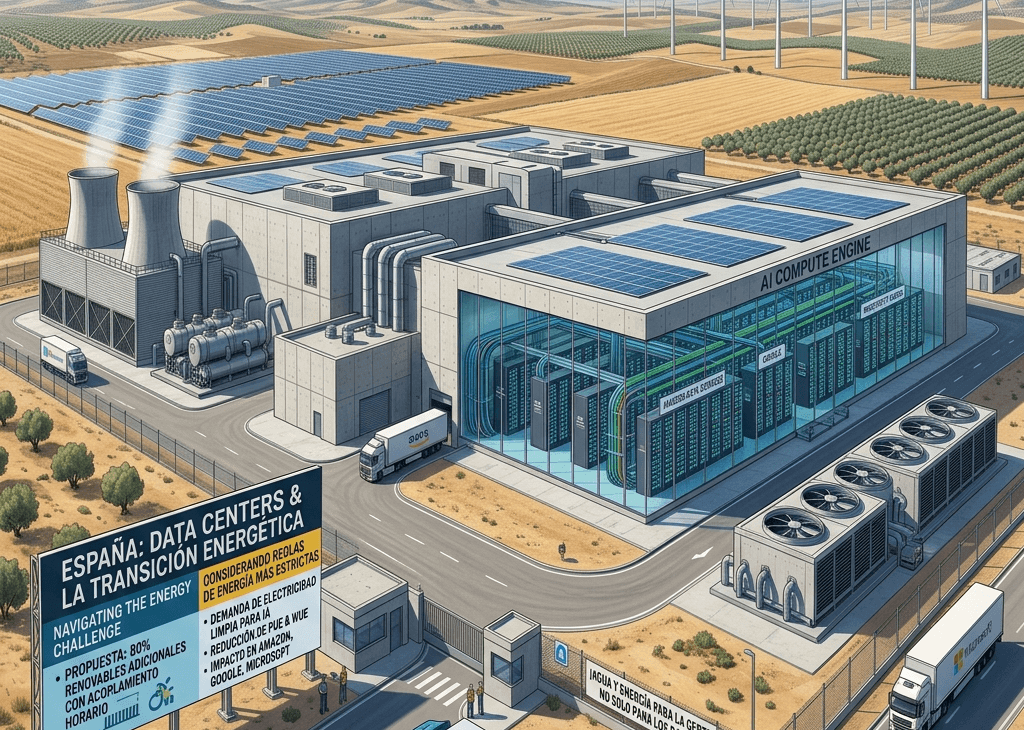
Data center energy rules are becoming a major issue for Big Tech companies in Spain. Amazon, Google and Microsoft are challenging proposed requirements that would push data centers to use at least 80% renewable electricity on an hourly basis. The companies warn that the strict requirements could make some large data-center projects more difficult and expensive to develop.
Spain Proposes 80% Renewable Energy Requirement
Spain’s proposed rules would require data centers with significant power consumption to meet strict energy and sustainability standards.
One of the most controversial provisions requires data centers to cover at least 80% of their electricity consumption with new renewable generation on an hourly basis. The draft rules aim to ensure that rapid data-center expansion does not place excessive pressure on Spain’s electricity system.
Unlike simply purchasing renewable-energy certificates or signing long-term power agreements, companies may find hourly matching much more difficult because renewable generation changes throughout the day.
Solar power, for example, produces much more electricity during daylight hours than at night. Wind generation can also vary depending on weather conditions.
This creates a major challenge for data centers that need reliable electricity 24 hours a day.
Amazon, Google and Microsoft Raise Concerns
Technology companies argue that the proposed requirements could create technical and economic difficulties for large data-center projects.
SpainDC has taken its objections to the Council of State, Spain’s supreme consultative body on legal and regulatory matters. The industry group argues that some provisions could prove technically and economically unworkable and may also raise legal concerns.
The industry’s concerns are significant because Spain has become an increasingly important destination for data-center investment.
Amazon, for example, announced plans earlier this year to invest €33.7 billion in Spain to expand data-center infrastructure supporting artificial intelligence and cloud computing.
Companies therefore want regulatory certainty before committing billions of euros to new facilities.
Why AI Is Making the Energy Problem Bigger
The debate comes at a time when artificial intelligence is rapidly increasing demand for data-center capacity.
AI workloads require powerful processors and large computing clusters. These systems consume substantial amounts of electricity and also require sophisticated cooling infrastructure.
The International Energy Agency says renewable energy will play a major role in meeting the growth in data-center electricity demand. Its analysis estimates that renewables could provide a significant share of the additional electricity required by data centers through 2035.
Technology companies are therefore investing heavily in clean-energy projects.
Google recently announced a €13 billion, or approximately $15 billion, investment in AI infrastructure in Finland. The company also agreed to purchase up to 50% of the output from a Finnish nuclear power plant under a 22-year agreement.
These investments show that major cloud providers are actively looking for reliable low-carbon electricity to support their growing AI infrastructure.
Investors Are Also Watching Spain’s Rules
The proposed regulations have attracted attention from international investors because of their potential effect on planned data-center investments.
Industry representatives have warned that the rules could affect a significant portion of the nearly €67 billion in data-center investment expected in Spain between 2026 and 2030. Investors have expressed concern that strict requirements could make some projects less attractive compared with alternative locations in Europe.
Spain’s government, however, argues that the regulations are necessary to manage the rapid expansion of data centers and reduce pressure on the country’s electricity and other infrastructure.
The government has received hundreds of objections to the proposed rules and is considering possible changes before it finalizes the regulations.
Could Data Centers Move to Other Countries?
One of the biggest questions is whether stricter regulations could push some planned data-center projects toward other European markets.
Industry representatives have warned that projects could become more difficult to develop if companies cannot obtain enough renewable electricity under the proposed hourly requirements.
This could increase competition between European countries for AI and cloud infrastructure investment.
Countries that can provide three things—large amounts of electricity, reliable grid connections and access to low-carbon energy—could become more attractive locations for new AI data centers.
At the same time, governments face a difficult balancing act. They want to attract investment and create jobs while preventing data centers from increasing electricity prices, putting pressure on the grid or creating additional environmental problems.
The Future of AI Data Centers Depends on Energy
The dispute in Spain illustrates a much larger global issue.
AI development is no longer limited by computing hardware and software. Access to electricity is becoming one of the most important factors determining where companies can build new AI data centers.
Microsoft, Google and Amazon are all expanding their data-center infrastructure, while other technology companies are also investing heavily in AI computing capacity. Microsoft, for example, reportedly plans to increase its global data-center capacity substantially over the coming years.
This means governments will increasingly have to decide how to balance AI growth with energy availability, renewable-energy targets, water consumption and grid stability.
Spain’s proposed 80% renewable-energy requirement could therefore become an important test case for other countries considering similar policies.
For technology companies, the message is clear: building the next generation of AI infrastructure will require not only powerful chips and cloud platforms, but also reliable and affordable clean electricity.
As AI demand continues to grow, the competition for energy could become just as important as the competition for computing power.
To know more topic on Cloud click here https://domainera.net/microsoft-azure-revenue-2026-aws-google-cloud/
AI Cloud Computing Data Center Energy Rules Data Centers Google Microsoft
Last modified: September 12, 2026