
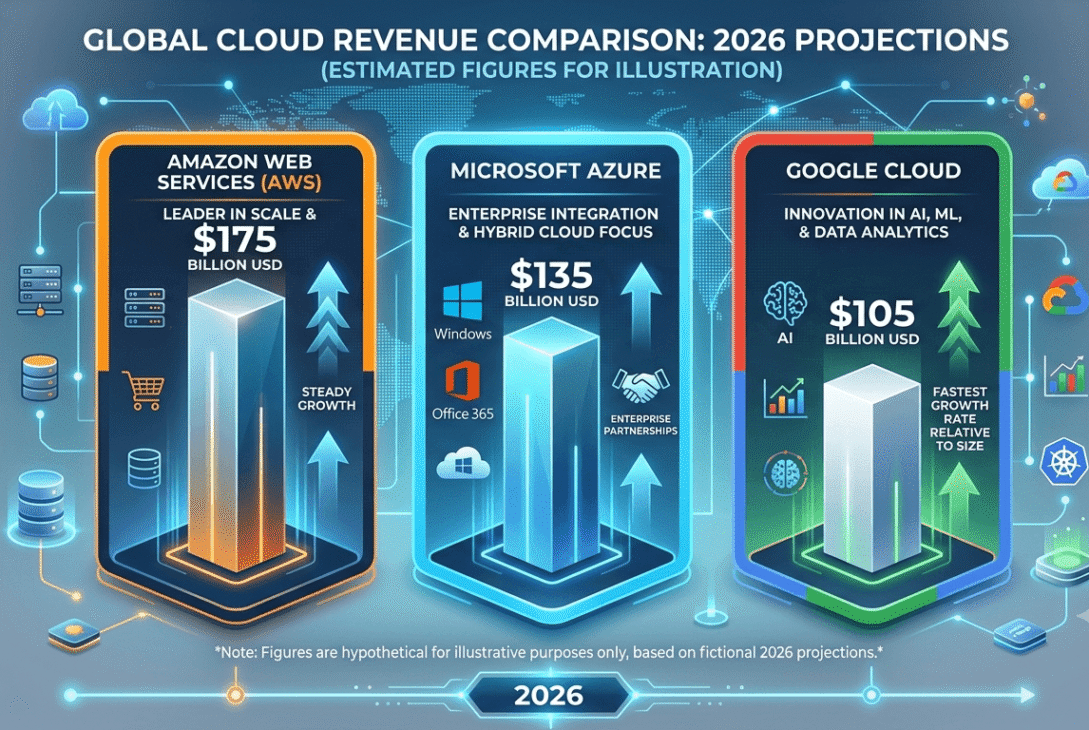
Microsoft has revealed its Azure cloud revenue for the first time, giving the market a clearer picture of how the three major cloud providers—Microsoft Azure, Amazon Web Services (AWS), and Google Cloud—compare in 2026.
The disclosure comes as cloud computing and artificial intelligence (AI) continue to drive massive investment in data centers, computing infrastructure and enterprise software.
Microsoft reported that Azure generated $29.4 billion in sales in its latest quarter and $101.9 billion during its fiscal year ended June 30, 2026.
The numbers put Azure behind AWS but ahead of Google Cloud in quarterly cloud revenue.
Microsoft Finally Reveals Azure Revenue
For years, Microsoft reported Azure’s growth rate but did not provide a standalone Azure revenue figure.
That changed on September 2, 2026, when Microsoft disclosed Azure’s sales figures as part of a broader change to its financial reporting structure.
Azure generated:
- $29.4 billion in quarterly sales
- $101.9 billion in sales for Microsoft’s fiscal year ended June 30, 2026
- 43% year-over-year growth for Azure and other cloud services in Microsoft’s fiscal fourth quarter
Microsoft’s own investor data shows Azure and other cloud services grew 43% year over year in fiscal Q4 and 41% for fiscal 2026.
This provides investors and businesses with a much clearer view of Microsoft’s position in the global cloud .
AWS vs Azure vs Google Cloud: 2026 Comparison
The latest quarterly figures show the current competitive position of the three major cloud providers:
| Cloud Provider | Latest Quarterly Cloud Revenue |
|---|---|
| Amazon Web Services (AWS) | $42.2 billion |
| Microsoft Azure | $29.4 billion |
| Google Cloud | $24.8 billion |
AWS remains ahead, but Azure is now significantly larger than Google Cloud based on these quarterly figures.
The comparison also shows how competitive the market has become.
AWS continues to benefit from its early lead in cloud infrastructure and its huge global customer base. Azure has a strong position among businesses already using Microsoft’s enterprise software. Google Cloud, meanwhile, continues to focus heavily on data analytics and artificial intelligence.
However, revenue is only one way to measure cloud-market strength.
Cloud providers are increasingly competing over AI infrastructure, computing capacity, networking, data platforms, security and developer tools.
Why Azure Is Closing the Gap With AWS
Azure’s strong growth is one of the most important parts of Microsoft’s cloud story.
Microsoft reported 43% year-over-year growth for Azure and other cloud services in fiscal Q4 2026 and 41% growth for fiscal 2026.
One advantage for Microsoft is its large enterprise ecosystem.
Companies already using Microsoft 365, Windows, GitHub and other Microsoft products can integrate Azure into their existing technology environments. This creates a powerful business advantage because customers may prefer to use cloud services that work closely with the software they already depend on.
Artificial intelligence is also helping Azure.
Microsoft has invested heavily in data centers and AI infrastructure to support growing demand for AI workloads. These investments allow Azure to provide computing resources for businesses developing and running AI applications.
The company is therefore competing on two fronts: traditional cloud computing and the rapidly expanding AI infrastructure market.
If Azure continues growing faster than AWS, the gap between the two companies could become increasingly important over the next few years.
Google Cloud’s AI Advantage
Google Cloud generated $24.8 billion in its latest quarter, placing it behind Azure in the latest revenue comparison.
However, Google Cloud remains an important competitor because of Google’s strong position in artificial intelligence and data technology.
Google has developed its own AI models, specialized computing infrastructure and machine-learning technologies. These capabilities give Google Cloud a strong foundation for businesses looking to build AI-powered applications.
Google’s experience with large-scale data processing is another important advantage.
The cloud competition is therefore not simply about revenue. A provider’s AI capabilities, infrastructure availability, pricing, security and developer ecosystem can all influence which platform businesses choose.
Google Cloud may have a smaller cloud business than AWS and Azure, but its AI capabilities could help it remain highly competitive as enterprises increase their use of generative AI and AI agents.
How AI Is Changing the Cloud Market
Artificial intelligence is changing the economics of cloud computing.
Advanced AI models require enormous amounts of computing power, specialized processors, high-speed networking and large data centers. As businesses deploy more AI applications, demand for cloud infrastructure is increasing.
This has created a new infrastructure race among AWS, Microsoft and Google.
Cloud providers are now investing billions of dollars in:
- AI data centers
- Specialized AI processors
- High-speed networking
- Cloud AI platforms
- Generative AI services
- AI agent infrastructure
- Data and analytics platforms
AI is also changing what customers expect from cloud providers.
Instead of simply renting storage and computing resources, businesses increasingly want complete platforms that allow them to develop, deploy and manage AI applications.
Microsoft is positioning Azure around this broader opportunity by connecting cloud infrastructure with AI services, Microsoft 365, GitHub and other enterprise products.
The same trend is visible across AWS and Google Cloud.
This means the next stage of the cloud race could be determined less by traditional infrastructure and more by who can provide the best combination of cloud, AI, data, security and developer services.
To know more topic on AI click herhttps://domainera.net/ai-domain-flipping-workflow-2026/
Who Is Winning the 2026 Cloud Race?
Based on the latest quarterly revenue figures, AWS remains the cloud market leader, with $42.2 billion in quarterly cloud revenue.
Microsoft Azure follows with $29.4 billion, while Google Cloud reports $24.8 billion.
However, Microsoft’s newly revealed Azure figures show that the company has built an enormous cloud business that continues to grow rapidly.
Azure’s strong growth, Microsoft’s enterprise customer base and its significant AI investments could allow it to continue challenging AWS.
Google Cloud also remains a serious competitor, particularly as artificial intelligence becomes increasingly important to enterprise technology.
The bigger story is that the cloud market is entering a new AI-driven phase.
The competition is no longer simply AWS vs Azure vs Google Cloud. It is becoming a competition over AI infrastructure, cloud platforms, data, AI agents and enterprise software.
As businesses continue moving AI workloads to the cloud, the provider that can deliver the best combination of performance, security, availability and cost could gain the biggest advantage in the years ahead.
AWS revenue projection AWS vs Azure vs Google Cloud cloud market share infographic cloud revenue comparison 2026
Last modified: September 3, 2026



[…] To know more topic on Cloud click here https://domainera.net/microsoft-azure-revenue-2026-aws-google-cloud/ […]