
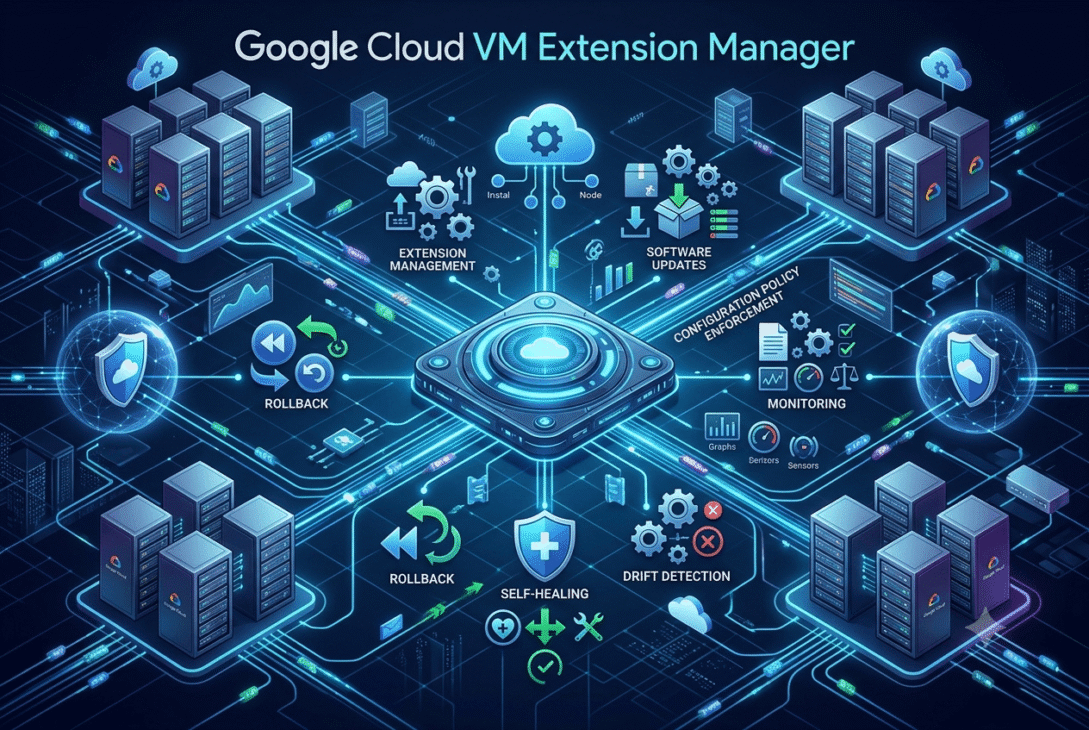
Google Cloud VM Extension Manager is now generally available, giving organizations a new way to automate the management of software extensions across Compute Engine virtual machines. The service replaces many custom startup scripts and manual processes with policy-based management for VM guest software.
Google announced the general availability of VM Extension Manager on September 4, 2026. The feature is designed to help IT and cloud teams maintain consistent software configurations across large fleets of virtual machines while reducing manual administration.
What Is Google Cloud VM Extension Manager?
Google Cloud VM Extension Manager is a policy-driven service for managing extensions installed on Compute Engine virtual machines.
Instead of connecting to individual VMs and installing or updating software manually, administrators can define policies describing the desired state of an extension.
Google’s earlier introduction of the service explained that it was designed to simplify the entire lifecycle of Google Cloud extensions, including installation and management across VM fleets.
This approach can be particularly useful for organizations managing hundreds or thousands of virtual machines.
For example, an organization may want the same monitoring agent installed and configured across its entire VM fleet. Instead of maintaining separate scripts for different machines, administrators can use VM Extension Manager policies to maintain a consistent configuration.
How VM Extension Manager Automates VM Management
The main advantage of VM Extension Manager is its policy-based approach.
Administrators define the desired configuration, and Google Cloud can apply that configuration across supported VM instances.
The service supports project-wide and zonal extension policies. Google Cloud documentation also says these policies can automatically install and manage extensions such as the Ops Agent across VM fleets.
This can help organizations maintain consistent configurations when:
- New VMs are created
- Existing VMs are updated
- Extensions need new versions
- Configuration changes are required
- Different VM zones need consistent software
- Administrators need centralized visibility
The goal is to move VM extension management from individual machine administration toward centralized cloud management.
Drift Detection and Automatic Self-Healing
One of the important capabilities associated with the generally available service is continuous monitoring of the desired and actual extension state.
If a VM’s configuration changes and no longer matches the policy, the system can detect the difference and take corrective action.
This concept is commonly called configuration drift.
For large cloud environments, configuration drift can become a major operational problem. One server may have a different agent version, another may be missing an extension, and a third may have an incorrect configuration.
Automated drift detection can help cloud administrators maintain a more consistent environment.
Google Cloud’s announcement describes VM Extension Manager as providing continuous drift detection with automatic self-healing.
Phased Rollouts and Automatic Rollbacks
Another important capability is controlled deployment across VM fleets.
Instead of changing every VM at the same time, organizations can use phased rollouts to introduce changes gradually.
This can reduce the risk of a configuration update affecting an entire environment simultaneously.
Google Cloud says VM Extension Manager supports multi-zone phased rollouts and automated rollbacks when a deployment fails.
For production environments, this can be particularly useful because administrators can reduce the potential impact of a faulty extension update or configuration change.
Why This Matters for Cloud Administrators
Managing VM software manually becomes increasingly difficult as cloud environments grow.
A company operating a handful of VMs may be able to manage software installations using scripts or manual procedures. However, the same approach becomes difficult when an organization operates hundreds or thousands of instances across multiple zones.
Google Cloud VM Extension Manager provides a centralized approach that can reduce repetitive administration.
It can help cloud teams:
- Standardize VM extension configurations
- Reduce dependence on custom startup scripts
- Manage software versions more consistently
- Detect configuration differences
- Automate corrective actions
- Monitor extension health
- Deploy changes in stages
Google’s documentation confirms that VM Extension Manager can be used to automatically install and manage extensions such as the Ops Agent across VM fleets.
What About Security?
Automated VM management can also have cybersecurity benefits.
Keeping monitoring and security-related software consistently installed can reduce the chance that individual machines are accidentally left without required protections.
For example, organizations using the Google Cloud Ops Agent can use VM Extension Manager policies for installation, version upgrades, and configuration management. Google Cloud’s release documentation lists these capabilities as generally available.
However, automation does not eliminate the need for security reviews.
Organizations should still carefully control:
- Which extensions are allowed
- Which VMs receive policies
- Who can modify policies
- Which versions are deployed
- How changes are tested
- What happens when an update fails
Poorly designed automation can potentially spread a bad configuration faster than manual processes, making testing and access control important.
Google Cloud’s Move Toward Automated Infrastructure
VM Extension Manager is part of a broader movement toward policy-driven cloud infrastructure.
Modern cloud environments increasingly rely on automation rather than manual server administration.
Instead of asking administrators to repeatedly perform the same operation on individual machines, cloud platforms can define a desired state and continuously work toward maintaining it.
This approach can improve operational consistency and reduce administrative workload.
For organizations running large Compute Engine fleets, VM Extension Manager could therefore become an important tool for managing the software layer running inside virtual machines.
What Businesses Should Know
Google Cloud VM Extension Manager is most relevant to organizations that operate multiple Compute Engine VMs and need consistent extension management.
Small environments may not immediately benefit from every automation feature. However, larger organizations can potentially save significant administrative effort by replacing scattered scripts and manual processes with centralized policies.
Before deploying the service across production systems, businesses should test policies in a controlled environment and confirm that existing startup scripts, extension configurations, permissions, and deployment processes do not conflict.
Conclusion
Google Cloud’s move to make VM Extension Manager generally available gives cloud administrators a more centralized way to manage VM guest extensions.
The service combines policy-based management with capabilities such as drift detection, self-healing, phased rollouts, automated rollback, and centralized monitoring.
For businesses operating large Compute Engine environments, the biggest benefit may be the ability to replace repetitive VM administration with automated, policy-driven management.
As cloud infrastructure continues to become more automated, tools such as VM Extension Manager could play an increasingly important role in keeping large VM fleets consistent, observable, and easier to manage.
To know more about Cloud topic click herehttps://domainera.net/sovereign-cloud-india-2026-compliance/
Cloud Automation Google Cloud VM Extension Manager
Last modified: September 10, 2026