
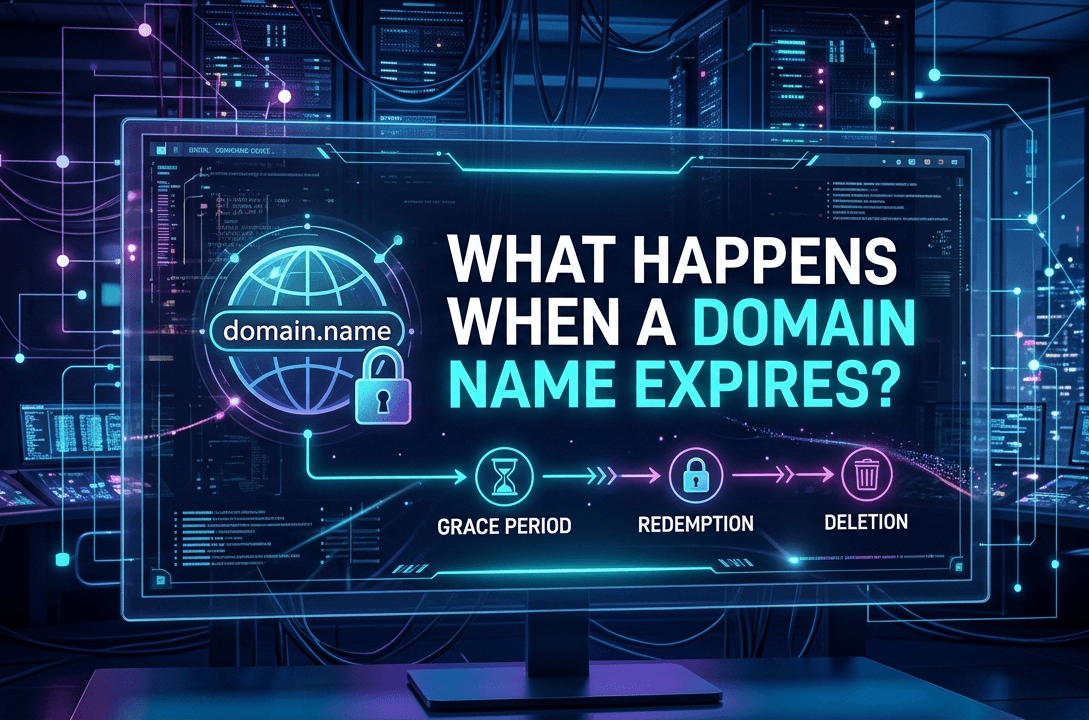
What happens when a domain name expires? This is an important question for every website owner. When a domain expires, the website and email services connected to it may stop working, and the domain can eventually be deleted and registered by someone else.
A domain does not usually become available immediately after expiration. It can go through several stages, including a renewal or grace period, redemption period, pending deletion, and eventual deletion.
What Happens During the Domain Grace Period?
The typical domain expiration process looks like this:
Expiration → Grace Period → Redemption → Pending Delete → Available for Registration
The exact process and timeframe can vary depending on the domain extension and registrar.
1. Domain Reaches Its Expiration Date
When your domain reaches its expiration date and is not renewed, the registrar may mark it as expired.
Your website may stop working, and services connected to the domain, such as email, can also be affected.
For example:
yourwebsite.com → Expired
Visitors may see an error page, parking page, or domain-expiration notice instead of your website.
2. Grace Period
After expiration, many domains enter a renewal or grace period.
During this time, the original owner may still be able to renew the domain through the registrar.
In some cases, renewal may be available at the normal price. However, the exact rules depend on the registrar and domain extension.
Tip: If your domain has expired, renew it as soon as possible rather than waiting.
3. Redemption Period
If the domain is not renewed during the applicable grace period, it may enter a redemption period.
Recovering a domain at this stage can be more expensive because the registrar may charge an additional restoration fee.
The exact redemption period and fees vary by domain extension and registrar.
4. Pending Delete
After the redemption period ends, the domain may enter Pending Delete status.
At this stage, the domain is scheduled to be deleted from the registry.
Recovery is generally no longer possible through normal renewal.
Once the deletion process is completed, the domain can become available for registration.
5. Someone Else Can Register the Domain
After the domain is deleted, another person or company may register it.
This can be a serious problem if the domain is:
- Your business name
- Your brand name
- A popular website address
- A domain with valuable backlinks
- An important email domain
If someone else registers your old domain, getting it back may be difficult or expensive.
What Happens to Your Website?
An expired domain can cause your website to become inaccessible.
This can result in:
- Website downtime
- Lost visitors
- Lost sales
- Broken links
- SEO problems
- Loss of customer trust
For an established business, losing a domain can have a much bigger impact than simply losing a website address.
What Happens to Email?
If you use an email address such as:
domain expiration can affect your email service.
You may stop receiving or sending emails if the domain’s DNS and mail services are no longer working.
This is why businesses should pay particular attention to domain renewal dates.
Can You Recover an Expired Domain?
Usually, yes—if you act quickly.
If the domain is still within its renewal or redemption period, you may be able to recover it through your registrar.
If it has already been deleted and registered by someone else, recovery becomes much more difficult.
The first thing to do is contact your domain registrar and check the current status of the domain.
How to Prevent Domain Expiration
You can reduce the risk of losing your domain by following a few simple steps:
Enable Auto-Renewal
Turn on automatic renewal with your registrar so the domain can be renewed automatically.
Keep Payment Details Updated
Make sure your payment method is valid so automatic renewal does not fail.
Check Your Email
Registrars usually send expiration and renewal notifications. Make sure your account email address is current.
Register Important Domains for Multiple Years
For important business domains, registering for multiple years can reduce the risk of accidentally forgetting the renewal date.
Domain Expiration Timeline
| Stage | What Happens |
|---|---|
| Expiration | Domain registration expires |
| Grace Period | Renewal may still be possible |
| Redemption | Recovery may require an additional fee |
| Pending Delete | Domain is scheduled for deletion |
| Deleted | Domain may become available again |
| Available | Someone else may register it |
Note: Exact timeframes and procedures vary by registrar and domain extension.
or more details, read our complete guide on domain nameshttps://domainera.net/glossary/
Frequently Asked Questions
Can I renew a domain after it expires?
In many cases, yes. However, the available renewal period and fees depend on the registrar and domain extension.
How long does an expired domain stay available to the original owner?
There is no single timeframe for every domain. Check your registrar’s expiration policy for the exact details.
Can someone buy my expired domain?
Yes. Once the domain is deleted and becomes available for registration, another person or company can register it.
Does an expired domain affect SEO?
It can. If the website becomes unavailable or the domain is permanently lost, visitors, backlinks, and search visibility may be affected.
How can I avoid losing my domain?
The easiest solution is to enable auto-renewal, maintain valid payment details, and monitor your domain expiration dates.
Final Thoughts
A domain name does not usually disappear immediately when it expires. It can move through several stages, including a grace period, redemption, pending deletion, and eventual deletion.
However, waiting too long can result in additional fees—or even permanent loss of the domain.
The best approach is simple: enable auto-renewal and renew important domains before they expire.
Domain Expiration Domain Registration Domain Renewal
Last modified: September 2, 2026




[…] To know more on Domain topic click herehttps://domainera.net/what-happens-when-a-domain-name-expires/ […]