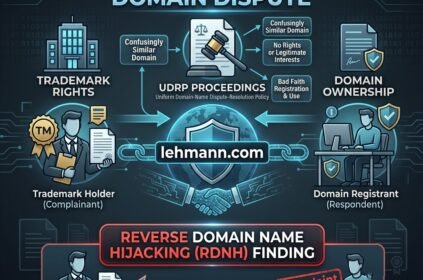
A UDRP domain dispute allows trademark owners to challenge domain names that they believe were registered and used in bad faith. However, the Uniform Domain Name Dispute Resolution Policy (UDRP) does not operate like a traditional trademark infringement court. Instead, it provides a specialized administrative process for resolving certain domain name disputes, especially cases involving cybersquatting.
Domain investors, website owners, and trademark holders should understand how the process works before registering, buying, or defending a domain name.
What Is the UDRP?
The Internet Corporation for Assigned Names and Numbers (ICANN) adopted the UDRP in 1999. The policy gives trademark owners a way to challenge certain domain registrations without immediately starting a traditional court case.
The UDRP applies to many generic top-level domains, including .com, .net, and .org. Some country-code domain registries also use similar dispute procedures.
An independent administrative panel reviews the complaint, the response, and the evidence submitted by both sides. If the complainant proves the required elements, the panel can order the transfer or cancellation of the domain name. The UDRP process does not provide monetary damages.
The Three Requirements of a UDRP Complaint
A complainant must establish all three elements under the UDRP:
- Identical or confusingly similar: The domain name must be identical or confusingly similar to a trademark or service mark in which the complainant has rights.
- No rights or legitimate interests: The registrant must have no rights or legitimate interests in the disputed domain name.
- Bad-faith registration and use: The complainant must show that the domain was registered and is being used in bad faith.
These requirements matter because trademark similarity alone does not automatically result in a successful complaint. The panel considers evidence related to all three elements.
How UDRP Differs From a Trademark Lawsuit
A traditional trademark lawsuit can address broader legal issues under the applicable law. Depending on the case, a court may consider infringement claims, damages, injunctions, and other legal remedies.
The UDRP takes a narrower approach. Its primary purpose is to resolve qualifying disputes involving abusive domain registration and use. A UDRP panel can order the transfer or cancellation of a domain, but the policy does not allow the panel to award financial compensation.
The UDRP also does not prevent either party from pursuing court proceedings where applicable law allows them to do so.
What Domain Owners Should Know
Domain investors and website owners can take several steps to reduce dispute risks.
Check trademarks before registering a domain. Search relevant trademark databases and consider whether the domain could target an existing brand.
Keep evidence of legitimate interests. Business plans, website records, correspondence, and other dated evidence can help demonstrate a legitimate reason for holding or using a domain.
Consider the meaning of the domain. A common dictionary word or descriptive domain is not automatically protected from a dispute. At the same time, similarity to a trademark does not automatically prove bad faith.
Respond to complaints on time. If you receive a UDRP complaint, carefully review the allegations and submit a response within the applicable deadline. Relevant evidence can play an important role in the panel’s decision.
Final Thoughts
The UDRP is a specialized administrative process rather than a full trademark infringement trial. Understanding its three requirements, available remedies, and relationship with court proceedings can help domain owners better understand their position in a UDRP domain dispute.
Disclaimer: This article is for informational purposes only and does not constitute legal advice.
To know more disput click herehttps://domainera.net/domain-dispute-lehmann-com-udrp-case/
Domain Dispute Domain Names UDRP
Last modified: October 1, 2026