
Imagine walking past a heavily armed corporate security checkpoint. The guards are checking bags and scanning badges thoroughly. They look closely at everyone entering or leaving the building. But right behind them, a mail carrier walks out the front door completely unquestioned. This carrier is carrying a bag full of letters. Hidden inside those regular envelopes are pages of highly classified company blueprints.
In the digital world, that mail carrier is the Domain Name System (DNS). Today, threat actors are weaponizing dns tunneling to turn this trusted protocol into a silent tool for corporate data exfiltration.
While IT security teams spend millions locking down firewalls, web traffic, and email servers, they often leave this specific back door wide open. Let’s break down exactly how this attack method works, why it easily slips past standard defenses, and how you can stop it.
The Trusted Intern of the Internet
To understand why weaponizing DNS is so highly effective, we first have to recognize how much trust we place in domain lookups. Think of DNS as the phonebook of the internet. When you type a user-friendly name into your browser, your computer does not inherently know where to go. It quietly asks a DNS resolver to translate that text into a machine-readable IP address.
Because this basic translation happens billions of times a day, firewalls treat DNS traffic with massive leniency. Most IT departments configure their security perimeters to let port 53 pass back and forth completely unhindered. After all, if you block DNS, your employees can no longer access the web. Your cloud applications will drop connections, and your daily business grinds to a sudden halt.
Cybercriminals are fully aware of this operational blindspot. They realize that if they want to sneak sensitive information out of a network, they do not need to fight their way through heavily guarded web filters. Instead, they can just write their stolen data onto a simple DNS query card and let your own network carry it out for them.
The Mechanics Behind Weaponizing DNS Tunneling
How exactly does a routine address lookup transform into a silent, weaponized data pipeline? The process is surprisingly straightforward. It relies on the natural architecture of recursive and authoritative web lookups.
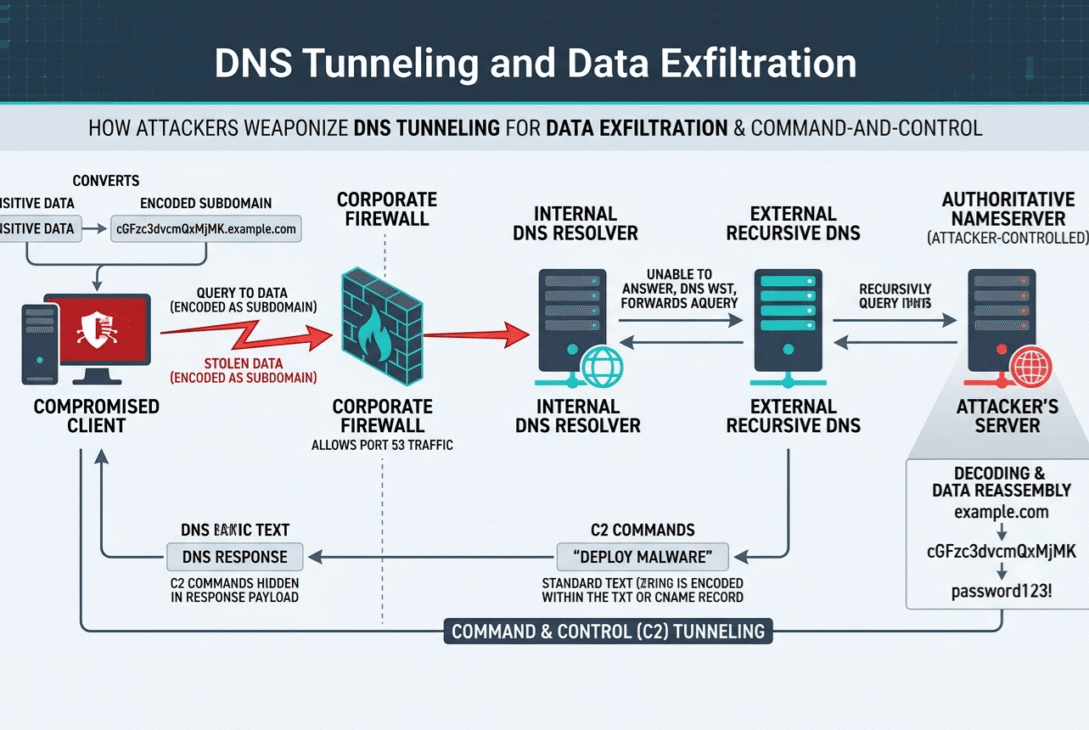
- Setting up the Target Endpoint: The attacker registers a seemingly harmless domain name. They set up a custom, malicious authoritative nameserver for it out on the public web.
- The Compromised System Steps In: Inside the target corporate network, malware compromises a local machine. It gathers sensitive information like customer databases, credit card hashes, or administrative passwords.
- Chop, Encode, and Packetize: Instead of uploading a large file over standard web protocols, the malware cuts the stolen data into small text strings. It then turns these strings into subdomains attached to the attacker’s main domain.
- The Unwitting Delivery: The infected machine sends a query to the company’s internal DNS resolver. The internal resolver does not recognize it, so it forwards it out to the root servers. This passes the data right along to the attacker’s server.
- Reassembly on the Other Side: The attacker’s server receives the request. It strips off the domain suffix, collects the unique subdomain text strings, and decodes them back into the original stolen files.
Consequently, the corporate firewall sees absolutely nothing out of the ordinary. As far as the security perimeter is concerned, an employee’s computer simply asked for a regular web location address.
Tunneling vs. Exfiltration: What’s the Difference?
While the terms are frequently thrown around together, they represent two distinct phases of a network cyberattack:
- DNS Data Exfiltration is strictly a one-way street. The attacker uses the outbound lookup pipeline to quietly carry sensitive data packets out of the network piece by piece.
- DNS Tunneling is a full, two-way communication channel. By leveraging the response payloads returned by the authoritative server, attackers can establish a persistent command-and-control infrastructure. This allows them to pass new operational commands back inside to the malware.
| Attack Feature | DNS Data Exfiltration | DNS Tunneling |
| Traffic Direction | Primarily Outbound | Bi-directional (Two-Way) |
| Primary Goal | Sneaking out internal data stealthily | Command-and-Control infrastructure |
| Complexity Level | Moderate | High (Requires steady connection) |
| System Impact | Immediate data breach | Long-term network compromise |
Why Traditional Firewalls Fail to Stop the Bleeding
The core issue is that traditional security tools look at the destination, not the payload behavior. Because the initial requests route through legitimate internal company resolvers, the network security posture registers the traffic as safe.
Furthermore, these chunks of data are incredibly small. Attackers do not rush the process. They trickle the queries out slowly over days or weeks. This low-and-slow strategy ensures the malicious packets blend right in with the massive, chaotic background noise generated by regular software updates.
Building a Modern Defense Strategy
Leaving port 53 completely unmonitored is no longer a viable option for modern enterprise infrastructure. Security teams must monitor their infrastructure actively. If you want to check your own records for anomalies, you can use our Domain Search and WHOIS Lookup Tool to review suspicious domains interacting with your network.
To secure your perimeter against threat actors weaponizing dns tunneling, look closely at incorporating these essential protective steps:
- Deploy Response Policy Zones (RPZ): An RPZ framework acts as a specialized reputation firewall built exclusively for domain lookups. By utilizing real-time threat intelligence feeds, it can instantly intercept and block queries traveling toward recently registered or known malicious domains. You can read more about global domain threat metrics in the authoritative Verisign Domain Name Industry Brief.
- Analyze Traffic Volumetrics and Entropy: Regular lookups typically use short, human-readable words. Weaponized queries, in stark contrast, feature long, highly randomized character strings. Security analytics tools can flag systems making an unusually high volume of unique subdomain lookups to a single external root destination.
- Adopt DNS over HTTPS (DoH) Safely: While encryption protects privacy, it can also hide malicious tunneling within standard web traffic. Ensure your internal network architecture routes all endpoints through centralized, inspecting secure resolvers. Do not let individual applications choose their own public, unmonitored DoH pathways.
Final Thoughts
The greatest strength of a DNS attack lies entirely in its simplicity. By turning a necessary, foundational utility tool into a hidden pipeline, threat actors can move right under your security radar.
Building a resilient digital perimeter requires looking beyond standard web filters. By actively monitoring, filtering, and analyzing your lookup behavior, you can ensure this essential internet directory remains a reliable utility rather than a silent tool for network compromise.
Last modified: July 30, 2026



[…] To know more about Weaponizing DNS Tunneling click herehttps://domainera.net/weaponizing-dns-tunneling-data-exfiltration/ […]