
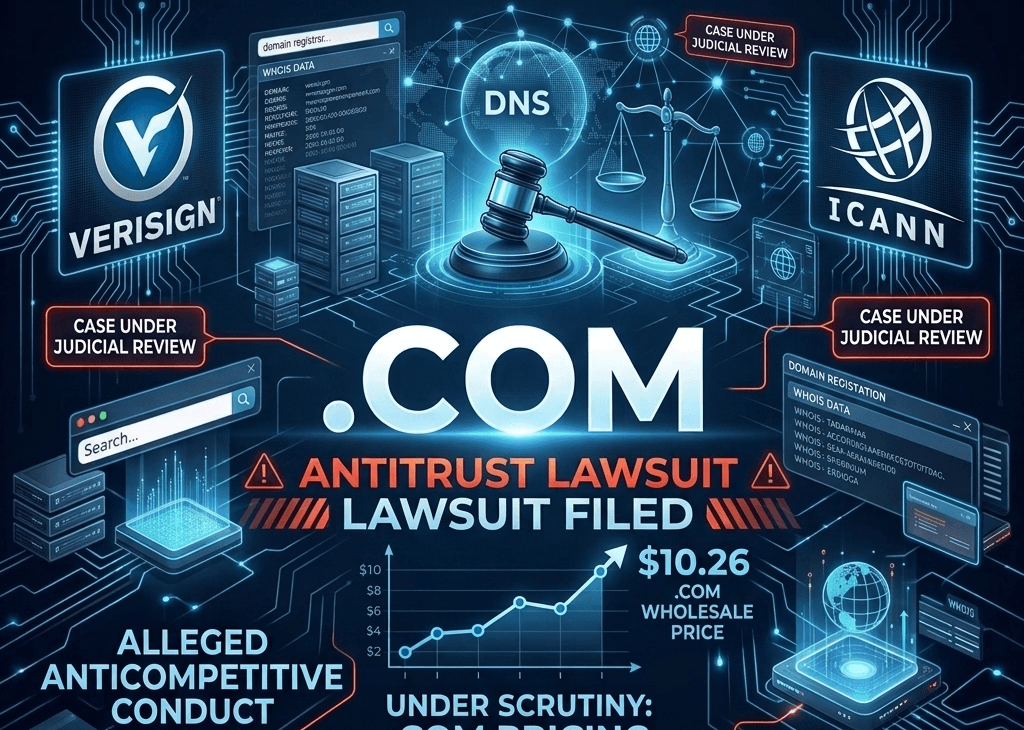
Verisign ICANN antitrust lawsuit is putting .COM domain pricing under fresh scrutiny. Verisign and ICANN are facing a proposed antitrust lawsuit over the pricing and operation of the .COM domain registry.
What Is the Verisign ICANN Antitrust Lawsuit About?
The Verisign ICANN antitrust lawsuit focuses on the pricing and operation of the .COM domain registry. The plaintiff alleges that agreements between Verisign and ICANN have helped maintain Verisign’s position in the .COM registry market.
Why Is .COM Pricing Being Challenged?
The complaint focuses heavily on increases in the wholesale price of .COM domains.
According to the plaintiff’s attorneys, Verisign’s wholesale fee increased from $7.85 in 2021 to $10.26, an increase of roughly 30%. Verisign has also announced another increase, with the wholesale fee scheduled to rise from $10.26 to $10.97 on November 1, 2026.
The wholesale price is different from the retail price customers pay to registrars because registrars may add their own pricing, services and fees.
Verisign’s Role in the .COM Registry
Verisign is the registry operator for .COM. Its current agreement with ICANN allows it to remain the sole registry operator for .COM through November 30, 2030.
Under the current pricing structure, Verisign can increase the annual registry-level wholesale fee by up to 7% in each of the final four years of each six-year pricing period, subject to the applicable contractual terms.
The pricing structure has been a subject of debate for years because .COM remains one of the most important domain extensions on the internet.
What Does ICANN Have to Do With It?
ICANN coordinates key elements of the global domain name system and has a contractual relationship with Verisign concerning the .COM registry.
ICANN has previously stated that it is not a competition authority or price regulator, and that pricing regulation for .COM has involved the U.S. Department of Commerce and Department of Justice framework.
Nevertheless, the new lawsuit argues that ICANN’s contractual arrangements with Verisign contributed to the alleged anticompetitive structure.
The complaint specifically challenges provisions that the plaintiff says restrict ICANN’s ability to regulate .COM wholesale pricing.
What Does the Plaintiff Want?
The lawsuit seeks several forms of relief.
The proposed nationwide class is seeking injunctive relief, which could potentially require changes to the practices or agreements challenged in the lawsuit.
A separate proposed California class is seeking monetary damages and other relief under state law.
The plaintiff is seeking to represent individuals and businesses that have paid to renew .COM domains since at least September 4, 2022.
Could the Lawsuit Affect Domain Owners?
The immediate impact on domain owners is uncertain.
The lawsuit does not automatically reduce .COM prices, and there has been no court ruling establishing that Verisign or ICANN violated antitrust law.
However, if the case survives and ultimately results in changes to the .COM pricing framework, it could have implications for:
- .COM registration prices
- .COM renewal costs
- Domain investors
- Businesses holding large domain portfolios
- Registrars
- The future pricing structure of the .COM registry
For businesses that manage hundreds or thousands of .COM domains, even a small change in annual pricing can have a meaningful financial impact.
Why This Matters to the Domain Industry
The case is significant because .COM remains one of the most widely used domain extensions worldwide.
ICANN’s own 2024 public-comment process on the proposed .COM registry renewal received concerns about the ability to increase maximum wholesale prices and calls for greater competition in the management of .COM.
The latest lawsuit therefore brings a long-running industry debate back into the spotlight: Should a single registry operator have the ability to increase .COM wholesale prices under a long-term contractual framework?
That question could become increasingly important as domain owners face higher registration and renewal costs.
What Happens Next?
The lawsuit will now move through the U.S. federal court system.
The court will first have to consider procedural and legal issues before the case can progress toward a potential class-action proceeding and a decision on the underlying antitrust allegations.
For now, domain owners should not assume that .COM prices will immediately change because of the lawsuit.
The case could, however, become an important legal development for the domain-name industry if the court allows the claims to proceed.
To know more about ICANN guideline https://domainera.net/icann-2026-round-guide/
Bottom Line
The proposed antitrust lawsuit against Verisign and ICANN puts the economics of the .COM domain registry under renewed scrutiny.
The plaintiff alleges that contractual arrangements have helped Verisign maintain an unlawful monopoly and charge excessive wholesale prices. Verisign’s current .COM wholesale fee is $10.26, with a previously announced increase to $10.97 beginning November 1, 2026.
However, these remain allegations, and the court has not determined that Verisign or ICANN violated antitrust laws.
The outcome could be important for domain investors, businesses, registrars and millions of .COM domain owners watching the future cost of maintaining their online identities.
antitrust lawsuit domain industry domain pricing
Last modified: September 8, 2026