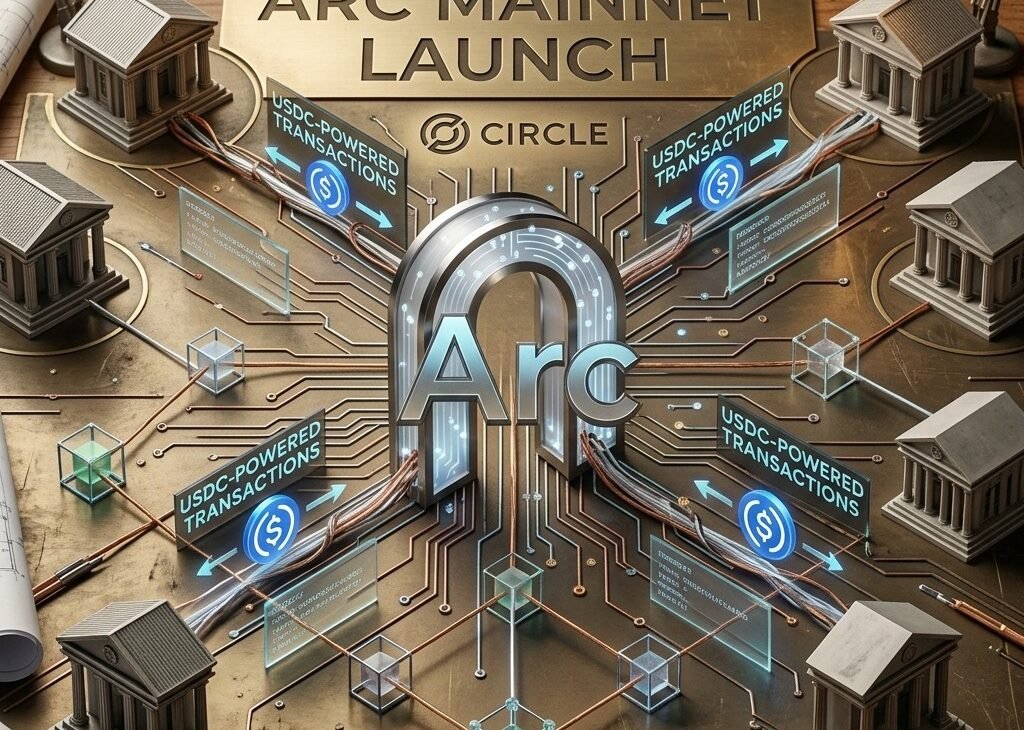
Circle has launched the public mainnet of Arc, a new Layer-1 blockchain for financial markets, stablecoin payments and digital finance.
Circle launched Arc on September 16, 2026. The network uses USDC to pay transaction fees. Users therefore do not need a separate volatile token for gas.
Circle says Arc launched with more than 100 applications. More than 100 institutional and ecosystem builders also joined the network. Its founding validator group includes BlackRock, Visa, Mastercard, DTCC and ICE.
What Is Circle Arc?
Arc is an EVM-compatible Layer-1 blockchain from Circle. The network targets financial applications instead of focusing only on cryptocurrency trading.
Circle built Arc for financial markets, payments and AI-driven economic activity.
One major feature sets Arc apart from many other blockchains. Arc uses USDC for transaction fees. Users do not need to buy another cryptocurrency just to pay network fees.
Arc also provides sub-second transaction finality. Circle designed this feature to support fast financial settlement.
Why Does Arc Use USDC for Gas?
Most major blockchains use a native asset for transaction fees. Ethereum, for example, uses ETH for gas.
Arc takes a different approach. The network uses USDC to pay gas fees.
This model could simplify blockchain payments for businesses. USDC maintains a value close to the U.S. dollar. Users can therefore pay network fees with a stablecoin instead of a volatile cryptocurrency.
USDC already supports cryptocurrency markets, payments and decentralized finance. Circle said more than $74 billion of USDC circulated when Arc launched.
Arc also supports other stablecoins and financial assets. Circle says the network supports more than 20 fiat-backed stablecoins. Tokenized assets such as BlackRock’s BUIDL and Circle’s USYC also operate within the ecosystem.
BlackRock, Visa and Mastercard Join Arc
Major financial institutions have joined Arc’s validator group.
Circle’s founding validator group includes BlackRock, DTCC, Galaxy, Global Payments, ICE, Mastercard, MoneyGram, SBI Group, Standard Chartered, Sumitomo Corporation and Visa. Circle plans to introduce the validators in phases.
Validators help operate and secure a blockchain network. Their participation also connects Arc with established financial infrastructure.
BlackRock plans to deploy its BUIDL tokenized fund on Arc. Circle and DTCC are also working on tokenizing DTC-custodied assets on Arc. They expect that work to begin in the second half of 2027.
Arc Launches With More Than 100 Applications
Arc launched its mainnet with more than 100 applications and services.
These applications cover decentralized finance, trading, lending, wallets, cross-chain infrastructure and payments.
Major protocols such as Aave, Morpho and Uniswap also support the ecosystem.
Arc supports the Ethereum Virtual Machine. Developers who already use Solidity and EVM tools can therefore build applications on Arc.
Circle has also released developer tools such as Arc Studio and Arc App Kits. These tools can help developers add payments, swaps and other blockchain functions to applications.
Arc Targets Stablecoin Payments and AI Agents
Circle also wants Arc to support an emerging AI-driven economy.
AI agents can perform tasks for people and businesses. In the future, these agents could manage payments, execute transactions and interact with smart contracts.
Circle says Arc can support this type of automated economic activity.
The company is also developing AgentVM. Circle designed AgentVM to help agents work with sensitive information while maintaining verifiable records on the blockchain.
This approach could expand the role of stablecoins. Software agents could eventually execute predefined financial transactions without requiring people to approve every individual payment.
What Happens Next for Arc?
Circle plans to develop Arc further after the mainnet launch.
The company says it may move Arc from its current Proof of Authority model toward Proof of Stake in 2027.
Circle also completed the genesis mint of 10 billion ARC tokens in September 2026. However, this technical milestone does not mean Circle has announced a public ARC token launch.
Circle says ARC could eventually support network security, utility and governance. Users will still pay transaction fees in USDC.
Circle also plans to develop privacy features, dedicated environments for financial applications, scalability improvements and stronger post-quantum protections.
Why Does Circle Arc Matter for Blockchain?
Arc shows how blockchain companies are moving beyond cryptocurrency trading.
Financial companies now explore blockchain infrastructure for payments, tokenized assets, financial markets and institutional settlement.
Arc combines several features for these use cases. These include USDC-based gas fees, sub-second finality, EVM compatibility and institutional participation.
However, Arc remains a new blockchain. Its future growth will depend on developer adoption, application usage, network performance and regulatory developments.
The network will also need businesses and financial institutions to move real economic activity onto the blockchain.
For the broader blockchain industry, Arc represents another step toward using stablecoins for real-world financial applications.
To know more about Crypto Currency click herehttps://domainera.net/bitcoin-price-rally-crosses-80000/
Arc blockchain Blockchain Circle Circle Arc mainnet crypto Cryptocurrency DeFi Layer 1 stablecoin Tokenization USDC
Last modified: September 17, 2026