
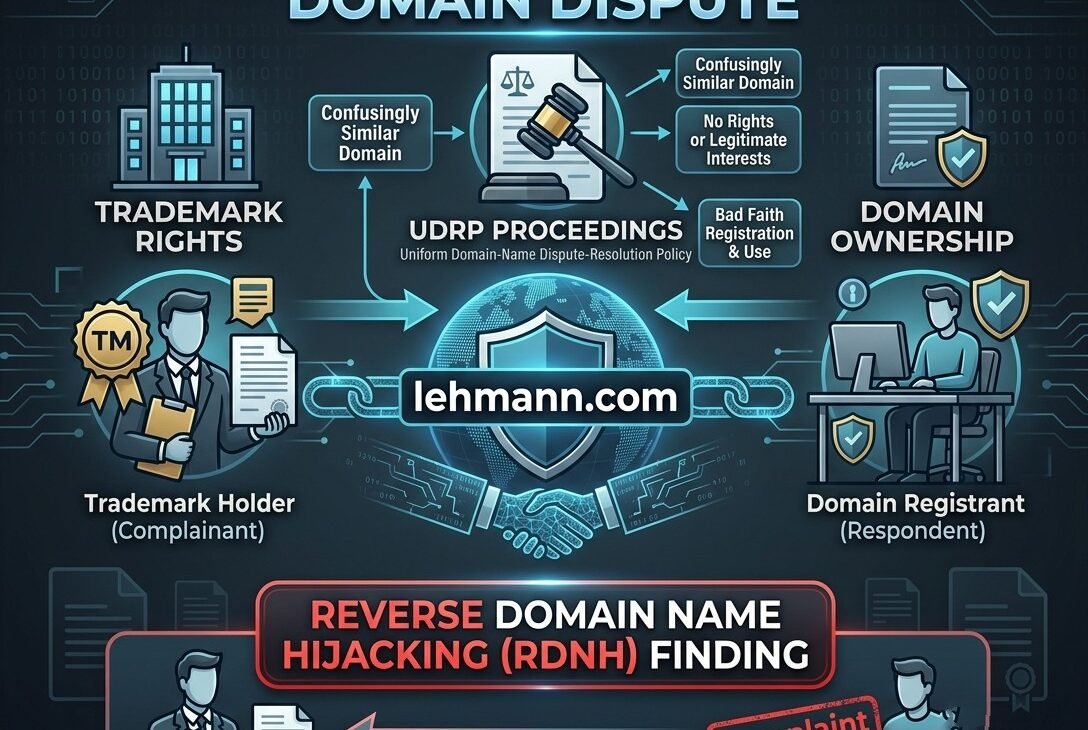
Domain dispute cases continue to affect businesses, trademark owners, domain investors, and registrants. A recent UDRP case involving Lehmann.com highlights an important lesson: owning a trademark that resembles a domain name does not automatically give a trademark owner the right to take control of that domain.
What Happened in the Lehmann.com Domain Dispute?
Otto Lehmann GmbH filed a UDRP complaint concerning Lehmann.com, a domain that Tucows held as part of a surname-domain portfolio.
Before the UDRP case began, both parties had already communicated about the domain. According to the published report, Otto Lehmann had attempted to acquire the domain from Tucows.
Tucows explained its ownership and the domain’s history during those communications. Despite those discussions, the complainant proceeded with a UDRP complaint.
The WIPO panel rejected the complaint because the complainant failed to establish the requirements needed to transfer the domain.
The panel also examined the parties’ previous correspondence. According to the published decision analysis, the complainant omitted material parts of those communications from its complaint. The panel considered that omission when it assessed the case and ultimately found Reverse Domain Name Hijacking.
How Does a UDRP Domain Dispute Work?
ICANN adopted the Uniform Domain Name Dispute Resolution Policy (UDRP) in 1999. The policy provides a process for resolving certain disputes involving abusive domain-name registrations. WIPO operates one of the major services that administers UDRP proceedings.
Generally, a complainant must establish three key elements:
- The domain name matches or closely resembles a trademark or service mark in which the complainant has rights.
- The domain registrant lacks rights or legitimate interests in the domain.
- The registrant registered and uses the domain name in bad faith.
All three elements matter.
Therefore, showing that a domain resembles a company’s trademark does not automatically guarantee a domain transfer.
UDRP panels examine the specific facts and evidence presented in each case. WIPO’s UDRP guidance also addresses trademark rights, legitimate interests, bad faith, and other circumstances that can affect a dispute.
Why Domain History Can Make or Break a Case
One of the most important evergreen lessons from domain disputes involves domain history.
A domain may have existed for many years before a trademark owner began using a particular brand. In other situations, an owner may use the domain for a legitimate business, surname, dictionary word, acronym, geographic term, or another unrelated purpose.
That history can help a panel determine whether a registrant targeted a complainant’s trademark.
For example, if a registrant acquired a domain before the complainant established trademark rights, the timing may become an important part of the dispute.
The same principle applies to domains that owners have used for legitimate purposes over a long period.
Domain investors should therefore preserve:
- Registration records
- Purchase records
- Previous website content
- Emails concerning the domain
- Marketplace listings
- Offers and negotiations
- Development records
- Business-use evidence
- Historical screenshots
- Trademark-related correspondence
These records can help an owner explain the circumstances surrounding a domain’s registration and use.
What Domain Owners Can Learn From the Lehmann.com Case
The Lehmann.com dispute provides several practical lessons for domain investors and businesses.
1. Keep Your Domain Records
Do not rely only on registration information. Keep documentation that shows when and why you acquired a domain.
2. Preserve Important Emails
If a trademark owner contacts you about a domain, preserve the complete correspondence.
Do not delete earlier emails, offers, negotiations, or explanations about the domain.
3. Understand Your Domain’s Meaning
A surname, dictionary word, acronym, or generic phrase may have legitimate uses unrelated to a particular trademark.
Understanding the domain’s meaning and history can therefore help establish its legitimate use.
4. Research Trademark Issues
Domain investors should research trademarks before acquiring potentially valuable brand-related domains.
A domain that looks attractive as an investment can create legal complications if it closely targets an existing trademark.
5. Understand That Not Every Domain Dispute Involves Cybersquatting
WIPO’s guidance recognizes that some disputes involve contractual or broader business disagreements that may fall outside the appropriate scope of a UDRP proceeding.
That distinction matters because a disagreement over ownership or a business relationship may require a different legal process.
The Bigger Evergreen Lesson for Domain Investors
The most important lesson is simple: domain ownership involves more than registration; evidence and history matter.
As domain names become increasingly valuable digital assets, disputes will remain an important part of the domain industry.
Businesses need to protect their trademarks and online identities. At the same time, legitimate domain owners need to understand their rights and maintain evidence that supports their ownership and use.
The UDRP provides a structured process for resolving certain domain disputes, but each case depends on its specific facts and evidence.
For domain investors, preparation can provide valuable protection. Understand a domain’s history, avoid obvious trademark conflicts, maintain documentation, and preserve important communications.
The Lehmann.com case demonstrates why these details can matter when a domain dispute reaches a UDRP panel.
Final Takeaway
The Lehmann.com dispute provides an evergreen lesson for anyone who owns, buys, sells, or manages valuable domain names.
A trademark and a domain name may look similar, but that similarity alone does not determine who should control the domain.
UDRP panels examine specific requirements, including trademark rights, legitimate interests, and bad faith. Evidence about the domain’s history and communications between the parties can also influence the outcome.
With WIPO reporting record levels of domain-name disputes, understanding the UDRP process has become increasingly important for trademark owners and domain investors.
For domain owners, the lesson is clear: keep your records, understand your domain’s history, and take every domain dispute seriously.
To know more topic on Dispute click herehttps://domainera.net/betwaynl-com-udrp-technical-analysis/
cybersquatting Domain Dispute UDRP WIPO
Last modified: September 18, 2026