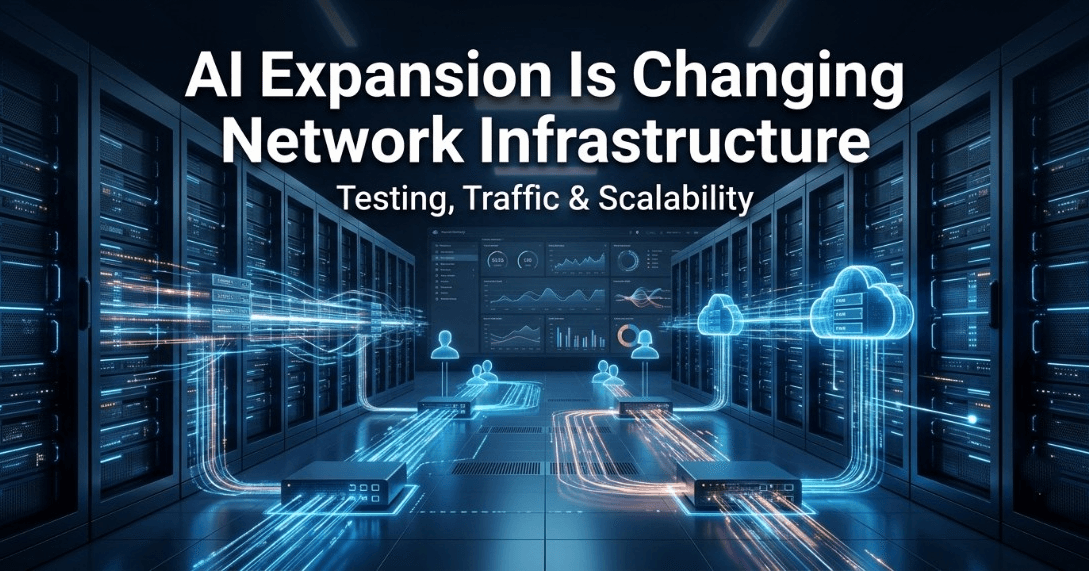
AI expansion and network infrastructure are becoming closely connected as businesses deploy more artificial intelligence applications across cloud platforms, data centers and enterprise networks. As AI workloads grow, organizations need to rethink how they test network performance, manage traffic and prepare infrastructure for future demand.
AI is not simply increasing the amount of data moving across networks. It can also change traffic patterns, workload requirements and the way infrastructure needs to be monitored. This is creating new challenges for network engineers and IT teams.
A recent CircleID analysis examines how the expansion of AI could affect network testing, infrastructure efficiency and capacity planning.
How AI Expansion Is Changing Network Infrastructure
Traditional network planning often relies on historical traffic patterns. Organizations estimate future demand based on previous usage, peak periods and expected business growth.
AI makes this process more complicated.
AI applications can generate different types of traffic depending on whether they are being used for model training, inference, data processing or enterprise applications. Multiple AI workloads can also operate simultaneously across cloud and data-center environments.
As a result, AI expansion and network infrastructure planning increasingly needs to consider not only how much traffic exists, but also how that traffic behaves.
Why Traditional Network Testing May Not Be Enough
Traditional network testing generally evaluates known workloads under controlled conditions.
AI workloads can be more dynamic.
A network may perform well during normal business operations but experience congestion when several AI applications simultaneously communicate with cloud platforms, databases or data centers.
Network teams should therefore test scenarios such as:
- Multiple AI workloads running simultaneously
- High-volume data transfers
- AI inference traffic
- Cloud-to-data-center communication
- Sudden increases in application demand
- Network congestion during peak workloads
- Security monitoring during heavy AI traffic
Testing these conditions can provide a better picture of how infrastructure will perform when AI adoption increases.
AI Expansion and Network Infrastructure Visibility
Better visibility is becoming one of the most important requirements for modern networks.
Organizations need to understand where traffic originates, where it goes and which applications consume the most resources.
Without this information, businesses may respond to performance problems by simply purchasing additional bandwidth or hardware.
However, the real problem could be:
- Poor traffic routing
- Inefficient applications
- Network configuration
- Data-center congestion
- Insufficient computing resources
- Security controls
- Unexpected AI workload behavior
Better monitoring can help organizations identify the actual cause before investing in additional infrastructure.
Why More Bandwidth Is Not Always the Solution
Increasing bandwidth can solve capacity problems, but it does not automatically solve every network-performance issue.
The effects of AI expansion and network infrastructure growth may require organizations to examine the efficiency of their existing systems.
Businesses may need to improve:
- Traffic classification
- Network routing
- Application efficiency
- Quality-of-service policies
- Cloud connectivity
- Data placement
- Network monitoring
- Infrastructure utilization
The correct solution depends on the specific bottleneck.
AI Is Changing Network Traffic Patterns
AI workloads can produce traffic patterns that differ from traditional web applications.
Cisco’s research predicts that AI inference could account for a significant share of network traffic in the coming years. Cisco estimates that AI inference traffic could represent 25% of total network traffic by 2035.
Cisco also highlights changes in the shape, duration, symmetry and criticality of AI-related network traffic.
This makes traffic visibility and workload classification increasingly important for AI expansion and network infrastructure planning.
AI Requires Smarter Network Testing
Network testing should increasingly reflect real-world AI workloads.
Instead of testing only maximum bandwidth, organizations should evaluate:
- Latency — How quickly does information move between systems?
- Capacity — Can the network handle increasing AI workloads?
- Reliability — Can critical AI services remain available?
- Scalability — Can infrastructure grow with demand?
- Security — Can unusual AI-related traffic be detected?
- Observability — Can teams identify bottlenecks quickly?
These measurements can help businesses understand whether their infrastructure is ready for wider AI adoption.
Security and Observability Are Becoming More Important
AI infrastructure also introduces security considerations.
As organizations connect AI applications with cloud services, databases, APIs and enterprise networks, security teams need visibility across these environments.
Unusual traffic, unexpected data transfers and suspicious connections should be investigated quickly.
Cisco’s AI infrastructure research emphasizes the importance of networking, security and observability when scaling AI environments.
For businesses, this means AI expansion and network infrastructure planning should not be separated from cybersecurity and monitoring.
How Businesses Can Prepare
Businesses do not necessarily need to replace their entire network because of AI.
A more practical approach is to measure current infrastructure and identify areas where AI workloads are creating additional pressure.
1. Map Existing Infrastructure
Create an inventory of network devices, cloud connections, data centers, applications and critical services.
2. Monitor Current Traffic
Track bandwidth, latency, packet loss, application traffic and peak utilization.
3. Identify AI Workloads
Find out which applications and teams are using AI and understand how those systems communicate.
4. Test Realistic AI Scenarios
Run tests that simulate multiple AI workloads instead of relying only on traditional network benchmarks.
5. Improve Network Visibility
Use monitoring and analytics tools to identify bottlenecks and unusual traffic patterns.
6. Review Network Policies
Consider whether important AI applications require different routing, security or quality-of-service policies.
7. Scale According to Evidence
Increase bandwidth, computing capacity or cloud resources where measurements show that additional capacity is actually required.
The Future of AI Expansion and Network Infrastructure
The relationship between AI expansion and network infrastructure will become increasingly important as businesses deploy more AI applications.
The challenge is not simply building larger networks. Organizations also need infrastructure that is efficient, observable, secure and capable of adapting to changing workloads.
AI inference is expected to become an increasingly important source of network traffic, making realistic testing and capacity planning more valuable.
Companies that begin measuring AI-related traffic now can identify infrastructure weaknesses before they become major performance or availability problems.
Final Thoughts
AI expansion and network infrastructure are now part of the same technology planning conversation.
As AI adoption grows, organizations should look beyond simply adding bandwidth. They should combine realistic testing, traffic monitoring, security, observability and evidence-based capacity planning.
The future network will need to be more than fast. It will need to be scalable, efficient, secure and adaptable to AI workloads.
Businesses that prepare their infrastructure early will be in a stronger position to support AI growth without unnecessary costs or unexpected network performance problems.
To know more about Top AI Tools by Category click https://domainera.net/top-ai-tools-by-category-guide/
AI Cloud Computing data center network infrastructure
Last modified: September 4, 2026